Europe's infrastructure is ageing. Across the continent, many structures are approaching or exceeding their design lives, representing a substantial and growing maintenance liability. Most of the time, deterioration is gradual and manageable.
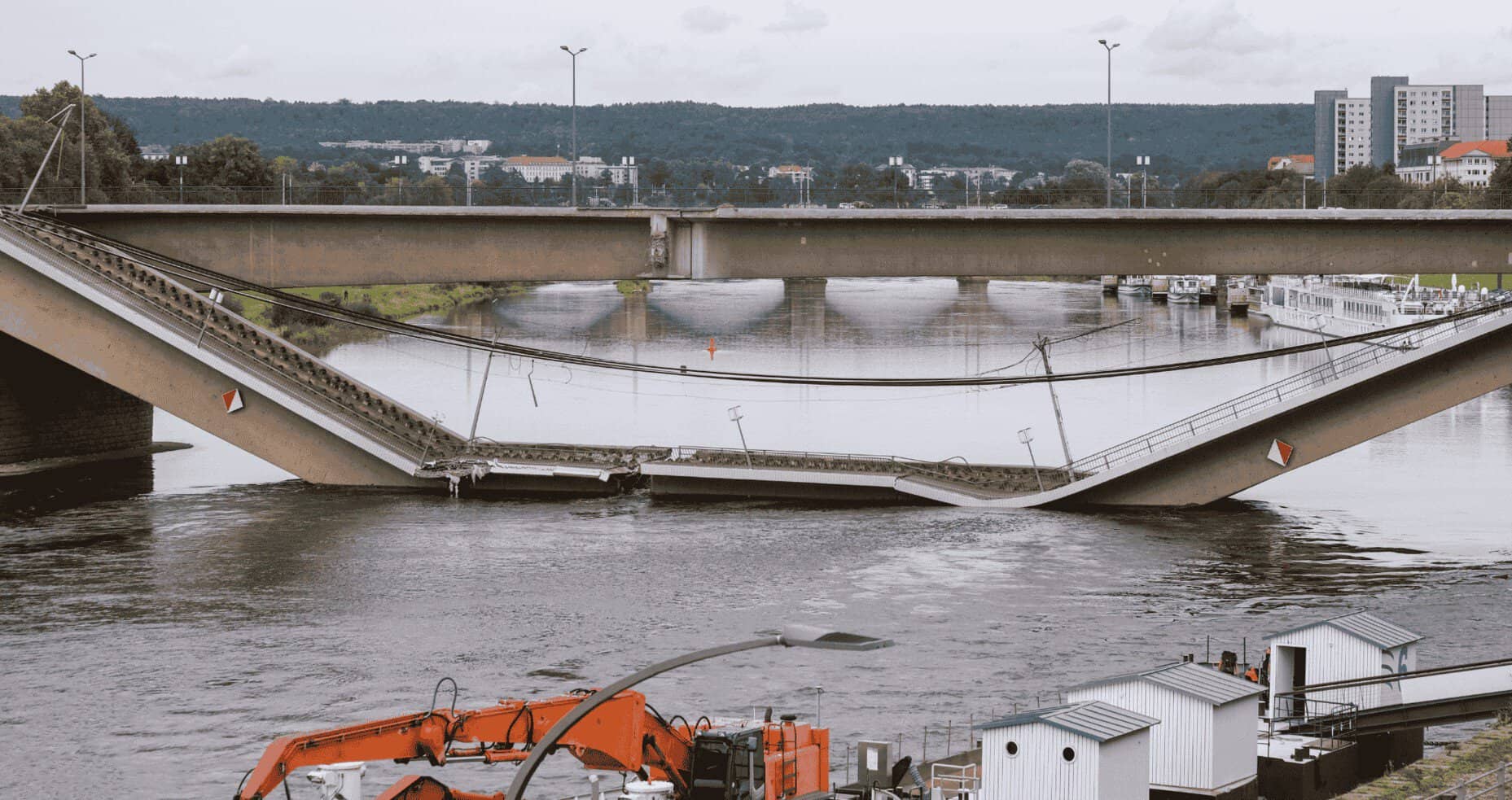
On 11 September 2024, a 100-metre section of the Carola Bridge in Dresden collapsed into the River Elbe. The bridge had been one of four main crossings in the city centre, carrying approximately 30,000 vehicles per day alongside two tram lines and significant pedestrian and cyclist traffic. The collapse occurred without warning at 2:59 AM, and by luck rather than design, there were no casualties.
An expert-led investigation identified hydrogen-induced stress corrosion within the bridge’s steel tendons as the primary cause. Over two thirds of the tendons, which maintain the required compressive stresses, were found to be severely damaged at the failure point.
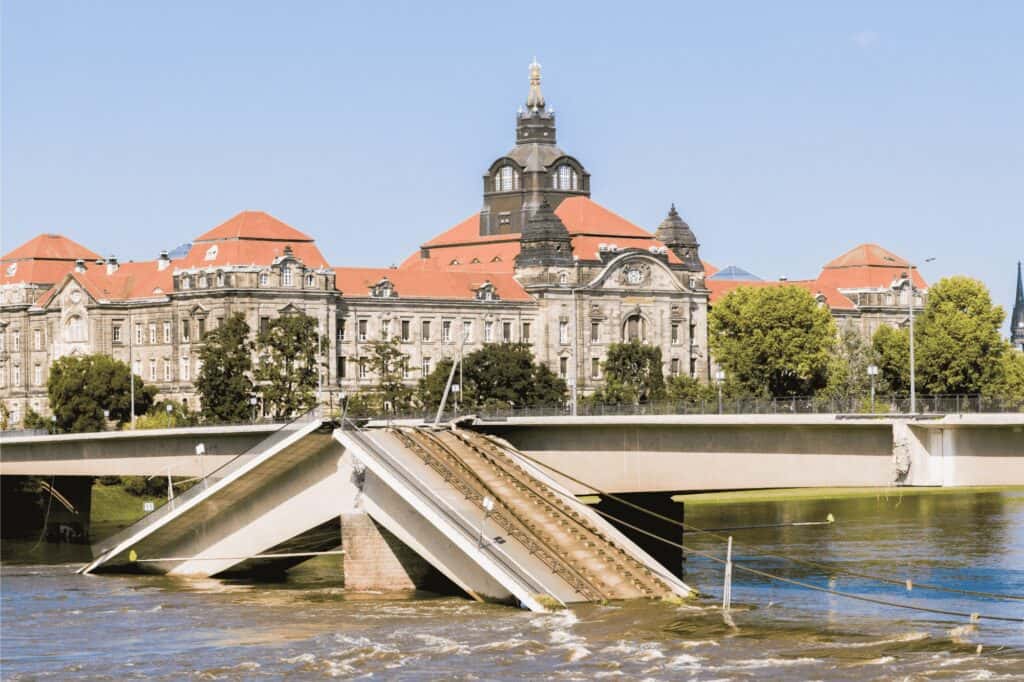
Since these tendons are concealed within the concrete box girder, the degradation was undetectable by conventional visual inspection methods. Specialised acoustic emission sensors are capable of detecting this type of hidden damage, but they must be deployed in advance.
Satellite InSAR analysis offers a fundamentally different proposition, it can observe the mechanical consequences of internal degradation from orbit, with no prior deployment required, and over historical data archives stretching back years.
InSAR Analysis of Carola Bridge
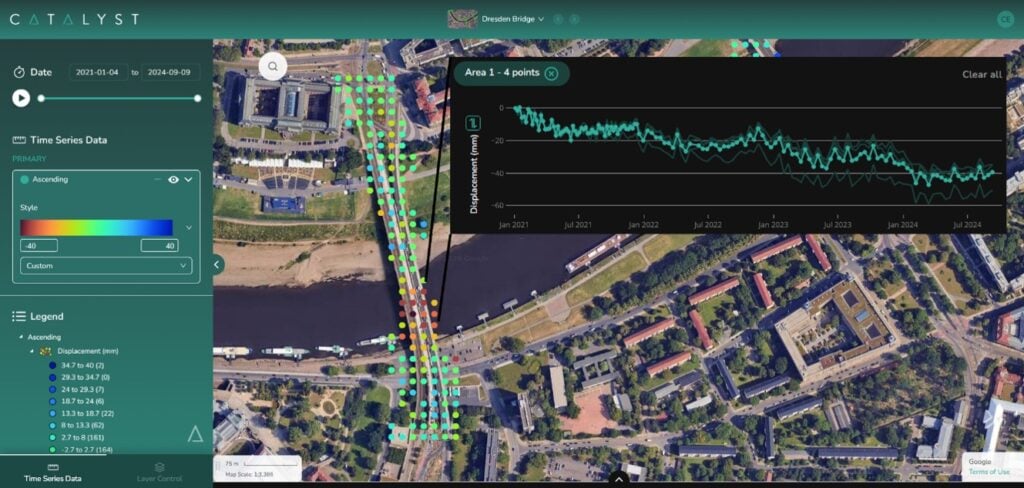
CATALYST’s analysis used dual line-of-sight (LOS) Sentinel-1 satellite data spanning January 2021 to September 2024, combining ascending and descending passes to decompose displacement into vertical and horizontal components. CATALYST's InSAR processing pipeline combines radar algorithms, available within CATALYST software, including proprietary InSAR modules to ensure rigorous and accurate ground displacement data.
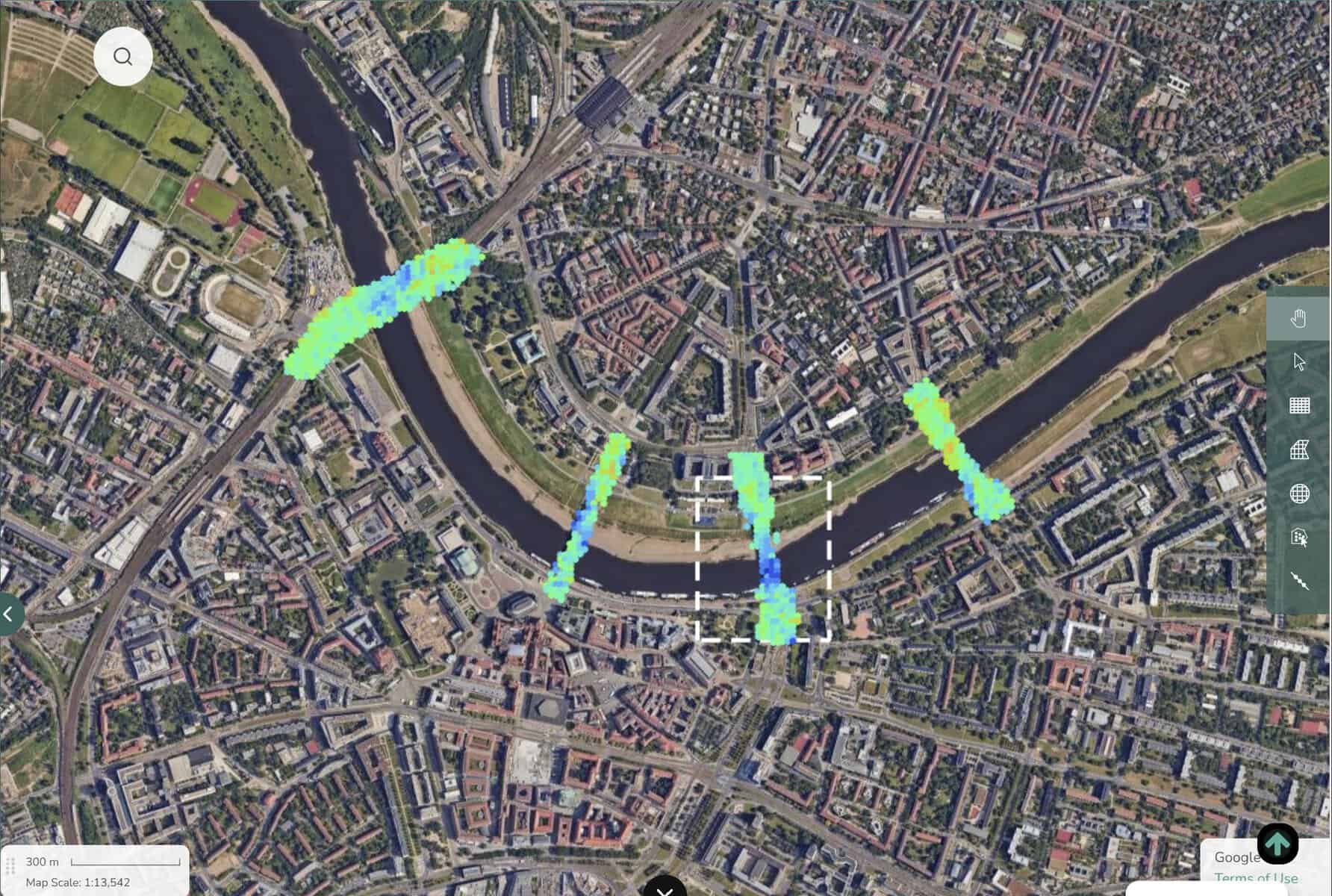
The ascending LOS time series showed a clear displacement hotspot at the exact location of the subsequent failure. Cumulative displacement reached a maximum of -38 mm over the analysis period, with a linear trend and a seasonal signal superimposed on it. In the descending direction, displacement was positive at the same location, indicating the movement had a significant longitudinal (horizontal) component rather than being purely vertical.
Decomposition of the two geometries yielded a cumulative eastward displacement of over 40 mm at the failure point, consistent with progressive structural deformation along the bridge axis as the tendon system degraded.
The Carola Bridge sits within a cluster of four crossings over the Elbe, which provides a useful comparative dataset within a single scene. On two of the remaining three bridges, displacement signals of a similar magnitude to Carola were visible. This required careful interpretation.
The analysis window of 3.5 years captured multiple seasonal cycles, and where a time series terminates mid-season, the unresolved seasonal component can masquerade as cumulative trend movement. To address this, CATALYST applied a purpose-built algorithm to separate seasonal and long-term displacement signals.
For example, the Marienbrücke bridge exhibits seasonal displacement amplitudes of up to 40 mm, a result that is operationally useful as it allows observed movement ranges to be compared against design tolerances.
Critically, once the seasonal component is isolated and removed across all bridges in the scene, the Carola Bridge stands out clearly as the structure with the greatest residual long-term displacement. Residual signals on other bridges do remain, indicating genuine long-term movement of varying degrees, but the Carola Bridge is the outlier.
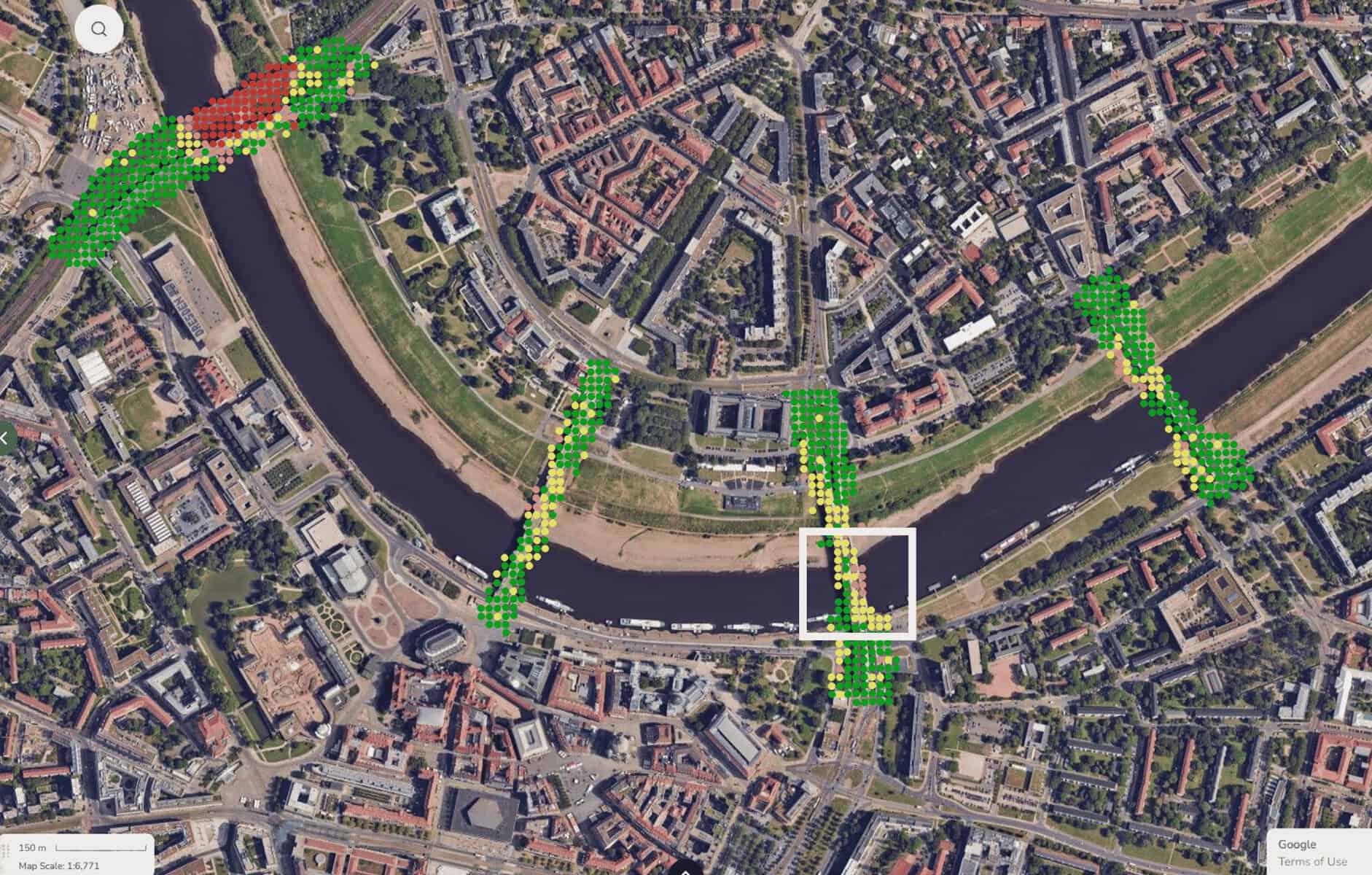
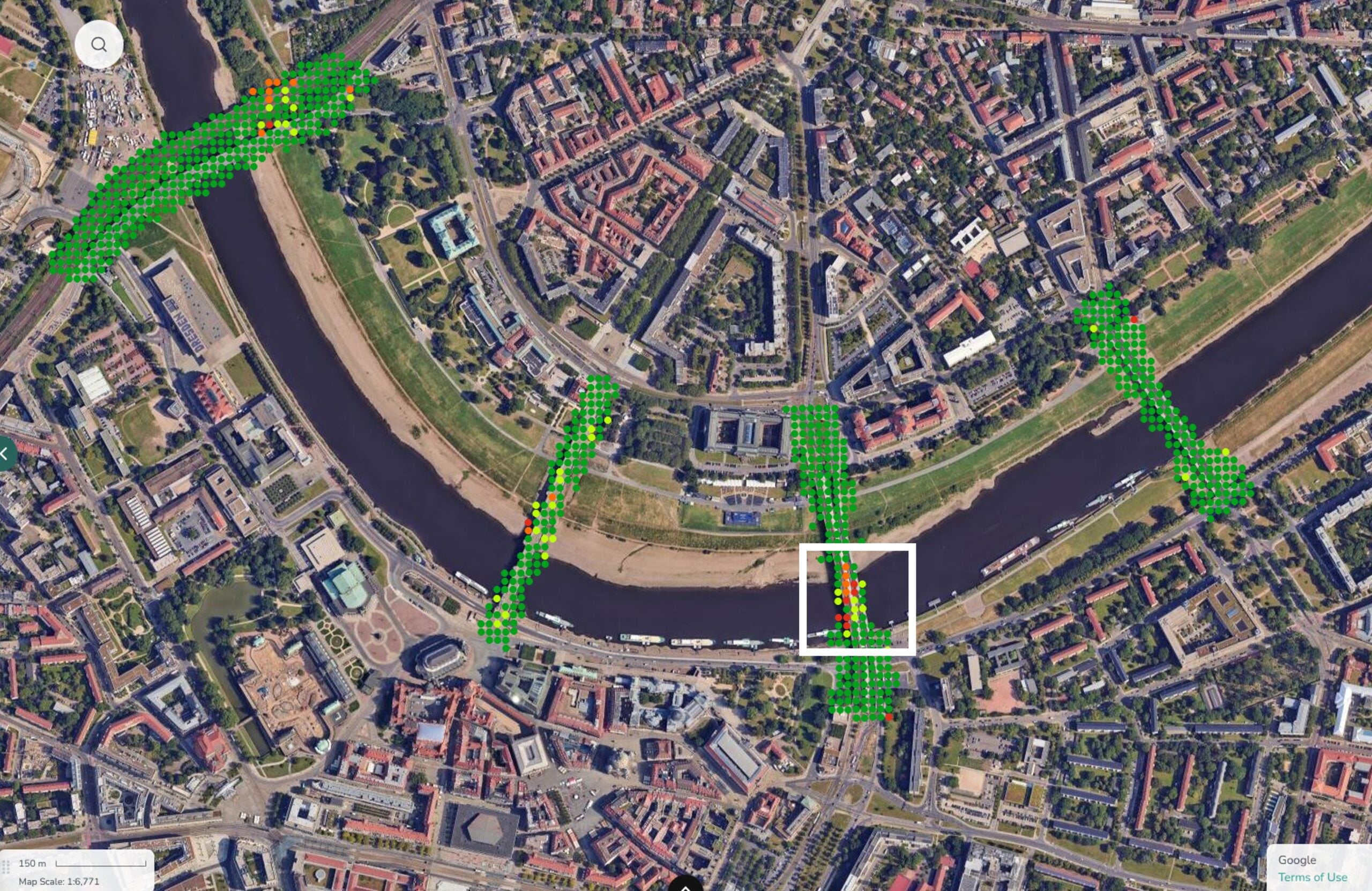
Figure 2 – Comparison between the amplitude of seasonal deformation (left) and long-term deformation with the seasonal signal removed (right). A standard traffic light colour scheme is used to easily identify areas of significant signal.
This finding has an important implication -the InSAR analysis did not detect the corrosion itself, but what the corrosion was doing to the structure. As the tendon system weakened, the bridge was deforming in ways that left a measurable kinematic signature. The satellite could see the mechanical consequence of an invisible failure process.
The Challenge of Ageing Infrastructure
Comparable prestressed concrete bridges make up around 70% of Germany's highway bridge stock, and the vulnerability exposed at the Carola Bridge is not unique to Dresden. A study by Transport & Environment found that 16,000 of Germany's bridges are inadequate. Of these, approximately 6,000 will need to be replaced entirely, with a further 10,000 requiring repair or upgrade.
The problem extends well beyond Germany. Ageing bridge stock in the United States and across Europe represents a vast inherited liability, with tens of thousands of structures approaching or exceeding their design lives under traffic loads that were never anticipated when they were built.
Dresden CATALYST INSIGHTS demo
The challenge is not just engineering, it is one of prioritisation and resource allocation. Inspection regimes cannot scale to the size of the problem, particularly where the relevant failure modes are hidden from visual survey. InSAR analysis offers a scalable complement: wide-area coverage, millimetric displacement sensitivity, fully remote operation, and access to multi-year archives that require no prior sensor deployment.
Component decomposition, such as separating seasonal and long-term signals, allows data to be interpreted meaningfully across different construction types and materials. The spatial resolution of available data can be matched to the latency monitoring need, from infrastructure corridors to individual asset level.
No single technology constitutes a complete structural health monitoring solution however, InSAR analysis is well placed for portfolio-scale triage by identifying assets within a large network that are showing anomalous behaviour and warrant closer investigation.
CATALYST works with infrastructure owners and operators to deploy exactly this capability across large asset portfolios, turning archive and live satellite data into actionable prioritisation for maintenance and replacement programmes.
CATALYST INSIGHTS

CATALYST OnBoard

CATALYST Professional

CATALYST Enterprise