The kappa value dictates the orientation of the image to north in the x and y plane. It is absolutely vital that the kappa rotation is known; otherwise, when you produce your orthorectified image results, the image will not be oriented correctly. Although the kappa value is provided in the exterior orientation (EO) file for each image in the project, in many cases an offset must be applied to the kappa value such that the orientation of the image to north is obtained.
Use the subset of imagery you used in the procedure in Plotting the position of imagery.
To verify that the kappa values provided in the EO file are sufficient for the imagery and flight lines
- In the EO file, identify the kappa value for each of the images in your sample two-by-two block.
-
Compare the kappa value against the orientation of the images you observed when loading them in CATALYST Professional Focus.
Does the kappa value provided reorient the images such that they are properly oriented to reflect the data-acquisition flight lines?
-
If the kappa value requires adjustment (that is, an offset), note it and keep this in mind.
For example, using the same data used in Plotting the position of imagery, determine the kappa rotation as follows:
-
The kappa values for each of the images in the sample two-by-two block are extracted from the EO file and are reproduced as shown in Table 1.
Table 1. Specifying map units for various coordinate systems Image ID Kappa (gradients) Kappa (degrees) 147_05296 -0.0404 -0.03636 147_05297 0.2723 0.24507 147_05336 199.5837 179.62533 147_05337 199.1285 179.21565 -
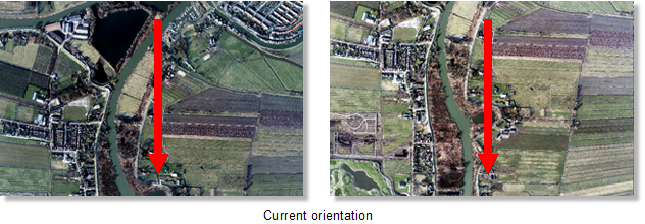
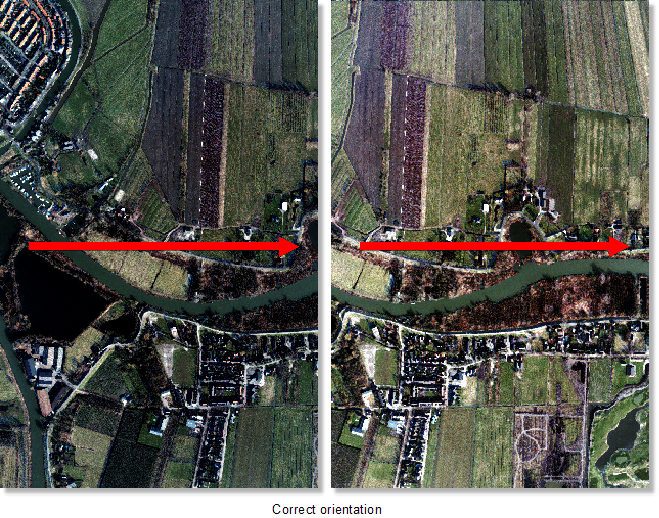
The kappa values should provide a rotation that rotates the imagery to its proper orientation. This means that, by applying the rotation, the flight line in the sample data set should reflect west-east and east-west. The images are displayed in Focus, but the kappa value provided does not properly orient the images.
-
By reviewing the current orientation with the current kappa value, it is apparent that an offset of 90 degrees must be applied to the current kappa values to get the proper orientation.
-