Parameter descriptions
Input: Input compact polarimetric SAR image
The name of the input CP data, which contains either two channels of complex-valued scattering data (Matrix type = s2c) or three channels of single-look or multilook covariance data (Matrix Type = C2r1c). Each image layer must have an identical transmit polarization that is neither horizontal nor vertical.
The input data can be a synthesized PIX (.pix) file created from a FP data set using CP configurations predefined by using PSCOMPACT or using configurations you define by using PSS2C. You can also import configurations from a CP data set by using SARINGEST or by specifying the key-file name of any GDB-supported CP data set in its distribution format.
For more information on ingesting SAR data with SARINGEST and GDB-supported file formats, follow the links at the end of this topic.
Output: Output compact polarimetric discriminators
The name of the output file containing the CP discriminators. The output file has the same dimensions as the input CP image and 11 real-valued channels. The orientation, ellipticity, relative phase, and alpha angle can be in degrees or radians. The output file contains one CP discriminator per channel in the following sequence:
- Degree of polarization
- Degree of circular polarization
- Degree of linear polarization
- Circular polarization ratio
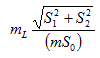
- Linear polarization ratio
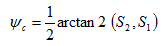
- Orientation
- Ellipticity
- Relative phase
- Coherence
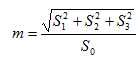
- Entropy
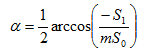
- Alpha angle
The output values for the degree of polarization, degree of linear polarization, circular polarization ratio, linear polarization ratio, coherency, and entropy will range from 0 to 1. The degree of circular polarization will range from -1 to 1, where positive values denote left circular and negative values right circular.
Orientation angles will range from -90 through 90 (or –pi/2 to pi/2), while ellipticity and alpha angles will range from -45 through 45 (or –pi/4 to pi/4) depending upon the value specified for the Angle units (ANGLETYP) parameter.
Relative phase is less than zero for odd bounce and greater than zero for even bounce.
Angle units
The unit of measure for the angle of the orientation, ellipticity, relative phase, and alpha angle: Degrees or Radians. The default is Degrees.
Details
PSCOMDIS calculates several CP discriminators for a CP data set.
The module verifies that the input file contains polarimetric layers created from a common transmit that is neither linearly horizontal nor linearly vertical. For example, acceptable configurations would be RH and RV or RR and RL, because the transmit polarization for each pair is identical (both are "R") and not equal to "H" or "V"). Unacceptable configurations include dual-polarimetric configurations, such as HH and HV, VV and VH, HR and HL, and similar configurations.
After establishing that the input meets the CP criteria, the four-element Stokes vector (S0, S1, S2, S3) is computed. The CP discriminators are each derived from the Stokes vector.
Relative phase is less than zero for odd bounce and greater than zero for even bounce. The degree of polarization ( ) and coherency (
 ) parameters are always equal to zero when single-look complex data is used as input.
References
Sabry R., Vachon P.W., "A Unified Framework for General Compact and Quad Polarimetric SAR Data and Imagery Analysis", IEEE Transactions on Geoscience and Remote Sensing, vol. 52, no. 1, January 2014.
Raney, R.K., "Dual Polarized SAR and Stokes Parameters", IEEE Geoscience and Remote Sensing. Letters. vol. 3, no 3. pp 317–319, July 2006.
Souyris, J.-C., Imbo, P., Fjortoft, R., Mingot, S., and Lee, J.-S., "Compact polarimetry based on symmetry properties of geophysical media: the pi/4 mode," IEEE Trans. Geosci. Remote Sens., vol. 43, no. 3, pp. 634–646, March 2005.
Souyris, J.-C. and Mingot, S., "Polarimetry based on one transmitting and two receiving polarizations: the pi/4 mode", Proceedings of the 2002 IEEE International Geoscience and Remote Sensing Symposium (IGARSS'02), vol. 1, June 2002, pp. 629–631.
Stacy, N. and Preiss, M., "Compact polarimetric analysis of X-band SAR data", Proc. of EUSAR'06, Germany, May 2006.
Raney, R. K., "Hybrid-polarity SAR architecture", IEEE Trans. Geosci. Remote Sens., vol. 45, no. 11, November 2007.
Nord, M. E., Ainsworth, T. L., Lee, J.-S., and Stacy, N. J. S., "Comparison of compact polarimetric synthetic aperture radar modes", IEEE Trans. Geosci. Remote Sens., vol. 47, no. 1, pp. 174–188, January 2009.
Bhavya, K.,B., "Polarimetric Modeling of Lunar Surface for Scattering Information Retrieval Using Mini-SAR Data of Chandrayaan-1", thesis, Faculty of Science and Earth Observation, University of Twente, March 2013.




 )
)
 )
)
 )
)
 )
)
 )
)
 )
)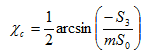 for left-handed systems
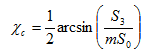 for right-handed systems
 )
)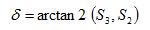 for left-handed systems
 for right-handed systems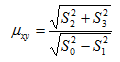
 )
)![-(1+m)/2*log[(1+m)/2 ]- (1-m)/2*log [(1-m)/2]/log(2)](../../../COMMON/references/images/PSCOMDIS_Frmla_2j.gif)
 )
)