PSCOMDEC
Apply decompositions to compact polarimetric SAR imagery
Description
PSCOMDEC creates a selectable compact polarimetric (CP) decomposition and separates it into components similar to the fully polarimetric (FP) Freeman-Durden decomposition. The CP total power is converted into individual components representing double-bounce, volume, and surface scattering power.
Parameters
| Name |
Type |
Caption |
Length |
Value range |
| FILI * |
String |
Input compact polarimetric SAR image |
1 - 192 |
|
| FILO * |
String |
Output compact polarimetric decomposition |
1 - 192 |
|
| DECOMPTYP * |
String |
Type of decomposition to apply |
1 - 7 |
m-chi|m-alpha|m-delta
Default: m-chi |
| MONITOR |
String |
Monitor mode |
0 - 3 |
ON, OFF
Default: ON |
* Required parameter
Parameter descriptions
FILI
The name of the input CP data, which contains either two channels of complex-valued scattering data (Matrix type = s2c) or three channels of single-look or multilook covariance data (Matrix Type = c2r1c). Each image layer must have an identical transmit polarization that is neither horizontal nor vertical.
The input data can be a synthesized PIX (.pix) file created from an FP data set by using predefined CP configurations in PSCOMPACT or by using ones you define by using PSS2C. You can also import input data from a CP data set using SARINGEST or by specifying the key-file name of any GDB-supported CP data set in its distribution format.
For more information on ingesting SAR data with SARINGEST and GDB-supported file formats, follow the links at the end of this topic.
FILO
The name of the output file to which to write the selected CP decomposition. The output file has the same dimensions as the input CP image and three real-valued channels representing double-bounce, volume, and surface scattering power respectively.
DECOMPTYP
The type of decomposition to apply.
The available options are:
The default is
m-chi.
During processing, the input string will be parsed to determine the required input.
MONITOR
The program progress can be monitored by printing the percentage of processing completed. A system parameter, MONITOR, controls this activity.
Available options are:
- ON: Turns the monitor ON (default)
- OFF: Turns the monitor OFF (recommended if running in batch or background mode)
Details
PSCOMDEC creates a CP decomposition based on the decomposition type you select.
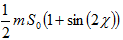
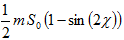
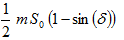
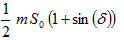
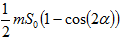
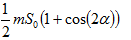
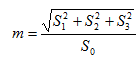
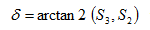
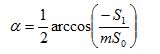
Decomposition is based on relating the Stokes parameters to the properties of the propagating wave and the scattering coefficients of the target. The three decomposition types, m-chi, m-delta, and m-alpha, are derived from the degree of polarization (m) and the ellipticity of the scattered wave (χ), relative phase between horizontal and vertical (δ), or scattering mechanism (α), respectively.
PSCOMDEC also verifies that the input file contains polarimetric layers created from a common transmit that is neither linearly horizontal nor linearly vertical. For example, acceptable configurations would be RH and RV or RR and RL, because the transmit polarization for each pair is identical (both are "R") and not equal to "H" or "V"). Unacceptable configurations include dual-polarimetric configurations, such as HH and HV, VV and VH, HR and HL, and similar configurations.
After establishing that the input meets the CP criteria, the four-element Stokes vector (S0, S1, S2, S3) is computed. The CP discriminators are each derived from the Stokes vector.
Example
Create a synthesized RCM CP data set (RH, RV) from FP RADARSAT-2 data by using PSCOMPACT. Apply a boxcar filter to the synthesized data and create the m-alpha, m-chi, and m-delta decompositions on the filtered data.
        EASI>FILI="RS2_SLC_FQ09subset.pix"
        EASI>FILO="RCM_RH_RV.pix"
        EASI>COMPTY="CTLR"
        EASI>run PSCOMPACT

        EASI>FILI="RCM_RH_RV.pix"
        EASI>FILO="RCM_RH_RV_BOXCAR5.pix"
        EASI>FLSZ=5,5
        EASI>run PSBOXCAR

        EASI>FILI="RCM_RH_RV_BOXCAR5.pix"
        EASI>FILO="RCM_BOXCAR5_m-alpha.pix"
        EASI>DECOMPTYP="m-alpha"
        EASI>run PSCOMDEC

        EASI>FILI="RCM_RH_RV_BOXCAR5.pix"
        EASI>FILO="RCM_BOXCAR5_m-alpha.pix"
        EASI>DECOMPTYP="m-chi"
        EASI>run PSCOMDEC

        EASI>FILI="RCM_RH_RV_BOXCAR5.pix"
        EASI>FILO="RCM_BOXCAR5_m-delta.pix"
        EASI>DECOMPTYP="m-delta"
        EASI>run PSCOMDEC
References
Raney, R. K. "Comments on the Calibration of Hybrid-Polarimetric Orbital SAR", presentation, ASAR Conference, Canadian Space Agency, St. Hubert, Canada, June 2011.
Raney, R. K. "M-Chi Decomposition of Imperfect Hybrid Dual-Polarimetric Radar Data", presentation, POLINSAR Conference, Frascati, Italy, January 2013.
Charbonneau F.J. et. Al. "Compact Pol Overview and Applications Assessment", Canadian Journal of Remote Sensing, vol. 36, suppl. 2, pp. 298–315, 2010.
Bhavya, K.,B., "Polarimetric Modeling of Lunar Surface for Scattering Information Retrieval Using Mini-SAR Data of Chandrayaan-1", thesis, Faculty of Science and Earth Observation, University of Twente, March 2013.
© PCI Geomatics Enterprises, Inc.®,
2026. All rights reserved.




 )
)
 )
) for left-handed systems
 for right-handed systems
 )
)
 )
)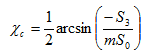 for left-handed systems
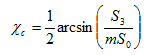 for right-handed systems