Topology is a mathematical representation of the surface features of a location. Topology involves not only building a relationship between the shape and the attributes, but also a relationship between the shapes themselves.
Topological lines
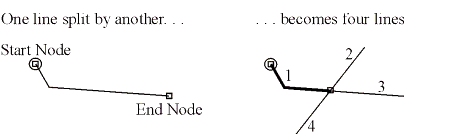
A topological line contains lines that use topological conventions. A topological line can contain several vertices, but only two nodes. A node is the start point or the end point of a line.
A topological line layer is composed of two layers. One layer stores the lines and the other stores the nodes. Focus generates and manipulates nodes in the node layer as you edit and create the topological lines.
Topological polygons
A topological polygon contains polygons that use topological conventions. A topological polygon is a closed figure formed by one or more topological lines that define the boundary of a specific location.
When a topological polygon overlaps another, the intersecting points become nodes; the lines are split, resulting in a new polygon in the overlap. That is, two topological polygons become three.
A topological polygon layer is composed of three layers. When you create a topological polygon layer, Focus also generates a line layer and a node layer. As you create and edit polygons, Focus manipulates the lines and nodes that form the polygon.
The line layer includes attributes that identify which polygons lie on either side of each line. The region outside the boundary of the digitized areas on the layer are represented by a global polygon. This global polygon, called Outside Area, appears as -1 in the Attribute Table for topological line layers. These attributes describe the relationship between the shapes.
